
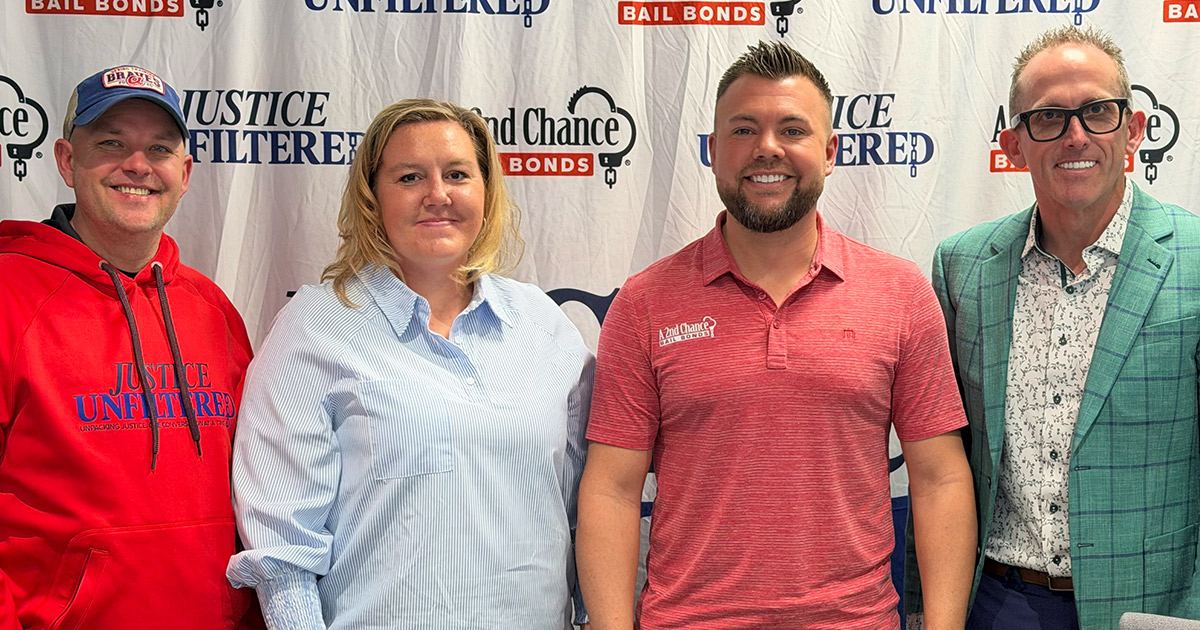
Most people don’t know how electronic monitoring and bail bonds work together. They hear “ankle monitor” and assume the worst. But the reality is a lot more nuanced. On this episode of Justice Unfiltered, hosts Daniel Matalon and Tug Cowart sat down with Jesse Fellabaum, Director of Operations at A 2nd Chance Bail Bonds, and Lyndi Schmidt, Director of Operations at A 2nd Chance Monitoring, to break it all down. What came out of that conversation was eye-opening.
Jesse has been with A 2nd Chance since 2010, and Lyndi joined about eight years ago after a career in human services and HR. Between them, they run two sides of the same mission: get people out of jail and keep them accountable as they rebuild their lives.
How Did A 2nd Chance Monitoring Get Started?
It started with a pattern. Clients coming through A 2nd Chance Bail Bonds kept needing GPS monitors alongside their bond. CEO Daniel Matalon kept seeing the same need over and over, so he looked into it. Then something bigger happened.
Decision-makers in Georgia started reaching out. People with real authority in the state had seen what A 2nd Chance was doing on the bail side and trusted the operation. They asked Daniel to look into building a monitoring company and offered contracts to bid on.
That came with serious pressure. As Jesse put it during the podcast:
“We’ve worked a very long time to build our reputation. It takes just a second to destroy it. So there was no margin for error.”
Lyndi stepped up, learned the operation, and helped build out the monitoring side from scratch. What exists today is a fully integrated system, with both companies working together under one roof.
What Is Electronic Monitoring? The Basics Explained
When someone is released from jail, a judge sometimes requires them to wear a monitoring device. This happens when the court believes a person can re-enter normal life, but needs an extra layer of accountability. Monitoring is not always tied to a bail bond, either. In many cases, a monitor is ordered without any bond at all.
A 2nd Chance Monitoring offers several types of devices depending on what the court orders:
- GPS ankle monitors: the most commonly known device, worn on the leg and tracking location in real time
- Wrist monitors: a less visible option that serves a similar tracking function
- Phone-based check-in apps: the person must check in through an app at randomized times throughout the day
- Continuous alcohol monitors (SCRAM CAM): worn on the ankle and pulling a transdermal alcohol reading approximately every 30 minutes
- Remote breath testing devices: the person blows into a device at required intervals to confirm sobriety
Lyndi put it simply on the podcast: “I like to think of it as more of an accountability tool.” The device is not a punishment. It is a structure that helps someone stay on track while their case works through the system.
How GPS Zones Work: Judges Set the Rules
One of the most common misconceptions is that ankle monitoring always means home confinement. That is not true. Many people on a GPS monitor go to work, run errands, and live their daily lives. The parameters are decided by the judge, not the monitoring company.
Here is how it works. When someone is released, they receive a bond order that outlines exactly where they are and are not allowed to go. A 2nd Chance Monitoring sets up zones in their system based on that order:
- Inclusion zones are places where the person is allowed to be, such as home, work, or a treatment facility
- Exclusion zones are places that they cannot enter, such as the location of a prior offense
The system tracks movement constantly. If someone leaves or enters a zone at the wrong time, it creates an alert. The A 2nd Chance Monitoring team then reviews the situation and determines the appropriate response based on the severity of the alert.
As Lyndi explained: “If you missed going to work because you had food poisoning, we are going to address that differently than if you showed up at the location of a prior offense.” Not every alert is treated the same. Context matters.
Common Myths About Electronic Monitoring (And the Truth)
Jesse and Lyndi spend a lot of time clearing up misinformation. A few of the biggest myths that came up in the podcast:
Myth 1: Listerine Can Trick a Continuous Alcohol Monitor
This one comes up constantly. The short answer is no. You would have to drink an unrealistic amount of mouthwash for it to register as a positive reading, and even then, the device is designed to detect the pattern of how alcohol metabolizes in the body. It looks for sustained increases in alcohol levels, not a single spike. If you use mouthwash and test 15 minutes later, the reading will be gone. The technology is far more sophisticated than most people assume.
Myth 2: Kombucha Causes False Positives
Kombucha does contain trace amounts of alcohol due to its fermentation process. Some people have tried to use this as an explanation in court. But as Jesse explained, the continuous alcohol monitoring devices track the full pattern of alcohol in your system, including the rise, the plateau, and the decline. Kombucha does not produce a sustained metabolic alcohol event. The data tells the full story.
Myth 3: Ankle Monitoring Always Means House Arrest
Many people on GPS monitoring go about their daily lives. They go to work, take their kids to school, and run normal errands. The conditions are set by the judge and are often much less restrictive than people imagine. The monitor is there to document, not to confine.
One-Stop Shop: Why Having Both Services Under One Roof Matters
In most cases, when a bond is posted, the family or attorney has to go find a separate monitoring company on their own. They might not know if that company is available, what the fees are, or how quickly they can get the device set up. That creates confusion and gaps at a time when speed matters.
A 2nd Chance handles both ends. When an attorney or court contacts them with a bond, they can immediately coordinate the monitoring setup on the other side. The paperwork, the payment, the device placement, all of it runs through one team. Jesse described it as being able to connect every dot from start to finish.
This also gives them something rare: when someone misses a court date and a bench warrant is issued, having the GPS data makes it far easier to locate that person and return them to the system as required.
Accountability Courts: Using Monitoring as a Tool, Not a Punishment
Across Georgia, counties operate what are called accountability courts. These are specialized courts designed around treatment and long-term supervision for specific situations. Common examples include:
- DUI Court
- Drug Court
- Veterans Court
- Mental Health Court
Participants in these courts follow a specific set of conditions for a set period of time, often around a year. If they complete the program successfully, they graduate. Electronic monitoring plays a key support role, especially early in the process when accountability is most critical.
Jesse and Lyndi have gone directly into courtrooms to advocate for clients, presenting monitoring as an alternative to incarceration. One point that stood out in the podcast: they have also pushed back on how long monitors stay on, even when keeping them on longer means more revenue.
“Do you want to rip the Band-Aid off or do you want to actually fix the problem?”
That is the philosophy: lead with what is right, not what is profitable.
Real Success Stories: What “Second Chance” Looks Like in Practice
A Mother, a Pregnancy, and a Path Forward
Lyndi shared one of the cases that sticks with her most. A young mother facing serious criminal charges was pregnant and was scheduled to give birth while incarcerated. Lyndi partnered with her attorney and testified before the judge, advocating for the woman to be released on a monitor so she could be home with her first child and give birth outside of jail.
The judge agreed. While out on the monitor, the woman got into drug classes and found a job. After giving birth, she did serve a short period of incarceration, but the judge counted her time on house arrest as time served. She is now doing well.
From the Pinnacle to the Last Chance
Jesse told the story of a man who had been at the top by every measure: a professional career, money, recognition. He fell into addiction and it cost him nearly everything. He ended up in jail in Cobb County. No bonding company would touch him.
Jesse got a call from the man’s mother. He called Daniel and didn’t even finish explaining the situation before Daniel said: help him. They posted the bond. Today, that man is married, healthy, and thriving. Jesse believes A 2nd Chance was his last option. They took the risk when nobody else would.
These are not outliers. They are the reason the company exists.
Why Daniel Matalon’s Story Is Part of the Mission
Tug asked a question during the episode that most people probably wonder. Why does Daniel take risks that others won’t? The answer is personal.
As Daniel said on the air, he understands where many of the people coming through the door have been. Not because he read about it. Because he has been there. His path to building A 2nd Chance came through failure, hard choices, and starting over. He knows what it feels like to need someone willing to roll the dice on you when no one else will.
That is not a marketing angle. It is the foundation of the company.
What Sets A 2nd Chance Apart in the Electronic Monitoring and Bail Bonds Space
A lot of companies offer bail bonds. A lot of companies offer ankle monitoring. Very few offer both with the kind of coordination, personalization, and advocacy that A 2nd Chance provides.
Here is a quick look at what makes the operation different:
- Fully integrated bail and monitoring services under one team
- Customized device options based on what the court orders and what the person actually needs
- Direct courtroom advocacy for clients seeking alternatives to incarceration
- A team that has personally worn and tested every device they offer
- A leadership team willing to take on cases others turn away
- Operations spanning 12 locations across Metro Atlanta and Alabama
Listen to the Full Episode of Justice Unfiltered
This conversation with Jesse and Lyndi is one of the most detailed looks at how electronic monitoring and bail bonds actually work in Georgia. You can catch the full episode of Justice Unfiltered on the 680 The Fan podcast network through The Podcast Park.
Listen here: https://www.thepodcastpark.com/justiceunfiltered/
Justice Unfiltered features conversations with judges, attorneys, law enforcement, and criminal justice professionals. New episodes drop on the first Monday of each month.
Need Help With Bail Bonds or Electronic Monitoring in Georgia?
If someone you know has been arrested and needs a bail bond or has been ordered to wear an electronic monitor, A 2nd Chance has the experience and the infrastructure to help. With 12 locations across Metro Atlanta and Birmingham and a fully staffed monitoring operation, they are available when it matters. Visit a2ndchancebailbonds.com or a2ndchancemonitoring.com to learn more.
Frequently Asked Questions About Electronic Monitoring and Bail Bonds
What is the difference between a GPS ankle monitor and a continuous alcohol monitor?
Who decides what conditions come with an ankle monitor?
Can mouthwash or kombucha cause a false positive on an alcohol monitor?
Can I still go to work if I am on an ankle monitor?
What is an accountability court in Georgia?
The Bottom Line on Electronic Monitoring and Bail Bonds
Electronic monitoring and bail bonds are tools, not judgments. Used correctly, they keep families together, allow people to keep working, and give individuals a real shot at turning things around before their cases are resolved.
What Jesse and Lyndi made clear in this episode is that the people they work with every day are not defined by the worst moment of their lives. Most of them just need someone willing to give them a structure and a shot. A 2nd Chance has built an entire operation around being that for people in Georgia and Alabama.
When you understand how electronic monitoring and bail bonds actually work together, the whole system looks a lot different.
Listen to the Full Episode
Hear the complete conversation on the Justice Unfiltered podcast, available wherever you get your podcasts or watch on YouTube.
📻 Atlanta’s ONLY All Conservative News & Talk Station: Xtra 106.
About Justice Unfiltered
Justice Unfiltered is a podcast presented by A 2nd Chance Bail Bonds and hosted by Tug Cowart and Daniel Matalon, CEO of A 2nd Chance Bail Bonds and A 2nd Chance Monitoring. The show airs on XTRA 1063 AM, Atlanta’s only conservative news and talk station, and features candid conversations with law enforcement, judges, attorneys, and voices from every part of the justice system. Listen to all episodes here.
About A 2nd Chance Bail Bonds
A 2nd Chance Bail Bonds serves clients across Georgia and multiple states, providing professional bail bond services 24 hours a day, 7 days a week. A 2nd Chance Monitoring offers GPS monitoring, alcohol monitoring, and other court-ordered monitoring solutions to help defendants meet their bond conditions while maintaining their daily lives.
Disclaimer: This article is for educational purposes only and does not constitute legal advice. If you are facing criminal charges, consult a licensed attorney in your jurisdiction.