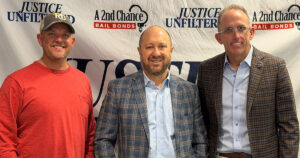

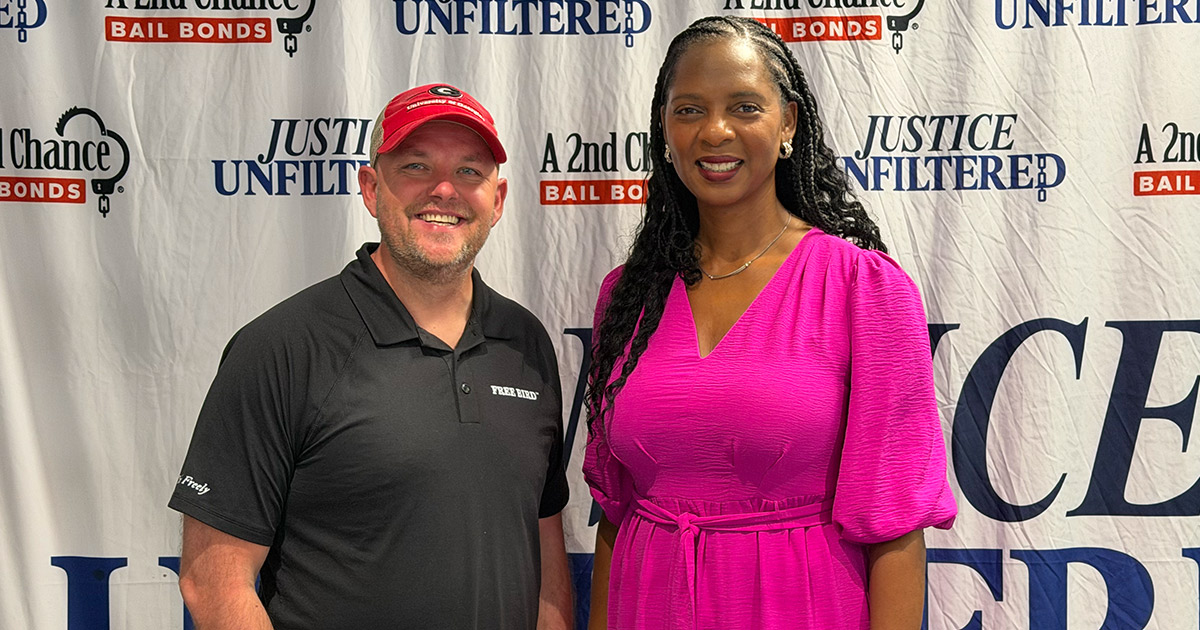
Joyette Holmes has held nearly every seat in Georgia’s justice system. Public defender. Prosecutor. Magistrate judge. District attorney. Now she chairs the Georgia State Board of Pardons and Paroles, where five people carry the responsibility of deciding when someone comes home.
She joined Tug Cowart on Justice Unfiltered for an honest conversation about second chances, the weight of those decisions, and a career built on firsts. Daniel Matalon could not be in the studio for this one, so Tug hosted the morning solo.
Who is Joyette Holmes?
Joyette Holmes is the chair of the Georgia State Board of Pardons and Paroles and a Valdosta native who has spent her whole career inside the justice system. Governor Brian Kemp appointed her to the board in January 2024. In September 2025, the board elected her chair, making her the second Black woman ever to lead it.
She earned her undergraduate degrees in psychology and criminal justice from the University of Georgia, then her law degree from the University of Baltimore School of Law. Along the way, she became the first Black woman and the first woman to serve as both chief magistrate judge and district attorney in Cobb County. As DA, she launched Project Restore 360, the county’s first record restriction and re-entry event.
A career that started with service (and a little Law & Order)
Ask her why she chose the law, and she will not give you a dramatic origin story. Her favorite show growing up was Law & Order. That was the spark. What sat underneath it was service.
Her dad is a retired Air Force veteran. Her mom is a retired registered nurse. Holmes never wanted either of those jobs, but she grew up watching her parents serve their community and step in as a safety net for families who hit a rough patch. She knew service had to be part of whatever she did.
She also grew up on a phrase from her Valdosta High coach: never, never, never quit. It stuck. The first time she ran for judge, she finished fifth in a field of five. She calls it one of the best things that happened to her, because the race taught her more about her community than any win could have.
What does the Georgia parole board actually do?
Everything the board does happens after a conviction. Holmes was clear about that. A person has already been through the court process, by plea or by trial, and is serving a sentence in the Department of Corrections before the board ever weighs a release.
Georgia has five board members statewide, and they review cases individually. Cases move from member to member until there is a majority. There is no formula. In Georgia, Holmes explained, parole is not a right. It is a discretionary decision, and the board weighs the full file: the facts of the case, victim input, the programs a person completed, disciplinary history, and letters from the community.
Holmes said the board has made a point of getting out from behind the desk. She described visiting Department of Corrections facilities across the state and meeting with district attorneys, sheriffs, victims, and defense attorneys so the whole community understands what the board looks at. According to Holmes, roughly 52,000 people are under the Department of Corrections’ supervision, and the majority will one day be released. That reality, she said, is what makes the work heavy.
Why second chances take a whole community
Holmes made a point that lands well beyond her board. A release only works if a person can build a life on the other side of it. Without a job, an education, or stable housing, the odds of going right back into the system climb.
So it takes employers willing to hire. Treatment providers. Community organizations. And, she said, it takes companies like A 2nd Chance Bail Bonds, who could just bond someone out and stop there but choose to be a bigger partner in the community. She pointed to the A 2nd Chance Community Foundation and its work with sheriffs, police, and fire departments, and nonprofits across Metro Atlanta.
She kept coming back to something small that is not small at all: backpacks. A kid who shows up to school with the same backpack as everyone else feels like they belong. Holmes tied that feeling straight to outcomes, noting the link people often draw between third-grade reading levels and the risk of ending up in the system later. Little things are not little.
Accountability is part of that picture too. Tools like electronic monitoring through A 2nd Chance Monitoring can help a person stay on track while a case moves forward or while they work toward a goal.
Leading the Ahmaud Arbery prosecution
As Cobb County DA, Holmes was appointed by the Georgia Attorney General to lead the prosecution in the Ahmaud Arbery case during its early and critical stages. The whole country was watching. She said her office approached it the way it approached any file, even though it was a case like no other.
The key, in her words, was removing the public sentiment. People were enraged, and she understood why, but prosecuting decisions could not be built on that. The question was what a jury could find beyond a reasonable doubt, and that is how the case was charged. She said public sentiment might have pushed for more people and more charges, but getting it right mattered more, especially for a family that had already been let down before the case reached her office.
Holmes left the district attorney’s office before the case went to trial. She credited the team in place for charging it in a way that set up the next group for success in front of the jury. She spoke with real care about Wanda Cooper-Jones and Marcus Arbery, and called Ms. Cooper-Jones one of the strongest people she has been around.
Forgiveness and finding the joy
One story stuck with her. At a national conference in New Orleans, Holmes heard from a man who had been the victim of a crime and later advocated for the release of the person who harmed him. Today the two work together. He recognized, she said, that he needed to forgive, and that being angry at someone should not mean they can never rejoin the community.
Holmes was quick to add the other side. Forgiveness does not always mean a person believes someone should be released, and the board does not discount a victim who feels that way. Every factor goes into the pot.
She lives up to her name. Joyette looks for the joy on the show and off it. When she is not working, she loves to travel, and she has picked up puzzles again to give her mind a rest. A Bora Bora overwater bungalow is on the list. So is Africa.
About A 2nd Chance Bail Bonds
A 2nd Chance Bail Bonds has been reuniting families for nearly 20 years. With multiple offices across Georgia and Alabama, our licensed bail bond agents are available around the clock to provide fast, respectful service to every family we work with. Whether the charge is a misdemeanor or a felony, we are here to help.
The information in this article is provided for general educational purposes only and does not constitute legal advice. Parole and pardon decisions in Georgia are made by the State Board of Pardons and Paroles on a case-by-case basis and are discretionary, so no outcome can be predicted from this article. Laws, procedures, and requirements in Georgia can change, and individual circumstances vary. If you have specific legal questions about your situation, please consult a licensed attorney in Georgia. A 2nd Chance Bail Bonds is a licensed bail bond agency, not a law firm.